Hypodermic Theory:
The "Magic Bullet" or "Hypodermic Needle Theory" of direct influence effects was not as widely accepted by scholars as many books on mass communication indicate. The magic bullet theory was not based on empirical findings from research but rather on assumptions of the time about human nature. People were assumed to be "uniformly controlled by their biologically based 'instincts' and that they react more or less uniformly to whatever 'stimuli' came along" (Lowery & De Fleur, 1995, p. 400). The "Magic Bullet" theory graphically assumes that the media's message is a bullet fired from the "media gun" into the viewer's "head" (Berger 1995). Similarly, the "Hypodermic Needle Model" uses the same idea of the "shooting" paradigm. It suggests that the media injects its messages straight into the passive audience (Croteau, Hoynes 1997). This passive audience is immediately affected by these messages. The public essentially cannot escape from the media's influence, and is therefore considered a "sitting duck" (Croteau, Hoynes 1997). Both models suggest that the public is vulnerable to the messages shot at them because of the limited communication tools and the studies of the media's effects on the masses at the time (Davis, Baron 1981). it means media explore a information in such a way that it injects in the mind of audiences as a bullets.

Inoculation Theory:
Inoculation is a theory developed to strengthen existing attitudes and beliefs and build resistance to future counterarguments. For inoculation to be successful it is critical that a threat (motivation for resistance) is imposed upon these existing ideas and refutational preemption (ability to cognitively build defenses to potential counterarguments) takes place after the inoculation. The argument that is presented through inoculation must be strong enough to initiate motivation to maintain current attitudes and beliefs, but weak enough that the receiver will refute the counterargument. Inoculation has been proven successful through many different trials and research. This article attempts to highlight all vital parts of the theory, however, there is a large amount of quality research on the theory that was not mentioned. Also, while numerous studies have tested the theory, there continues to be a need for improvement and new hypotheses.
Two Step Flow Theory:
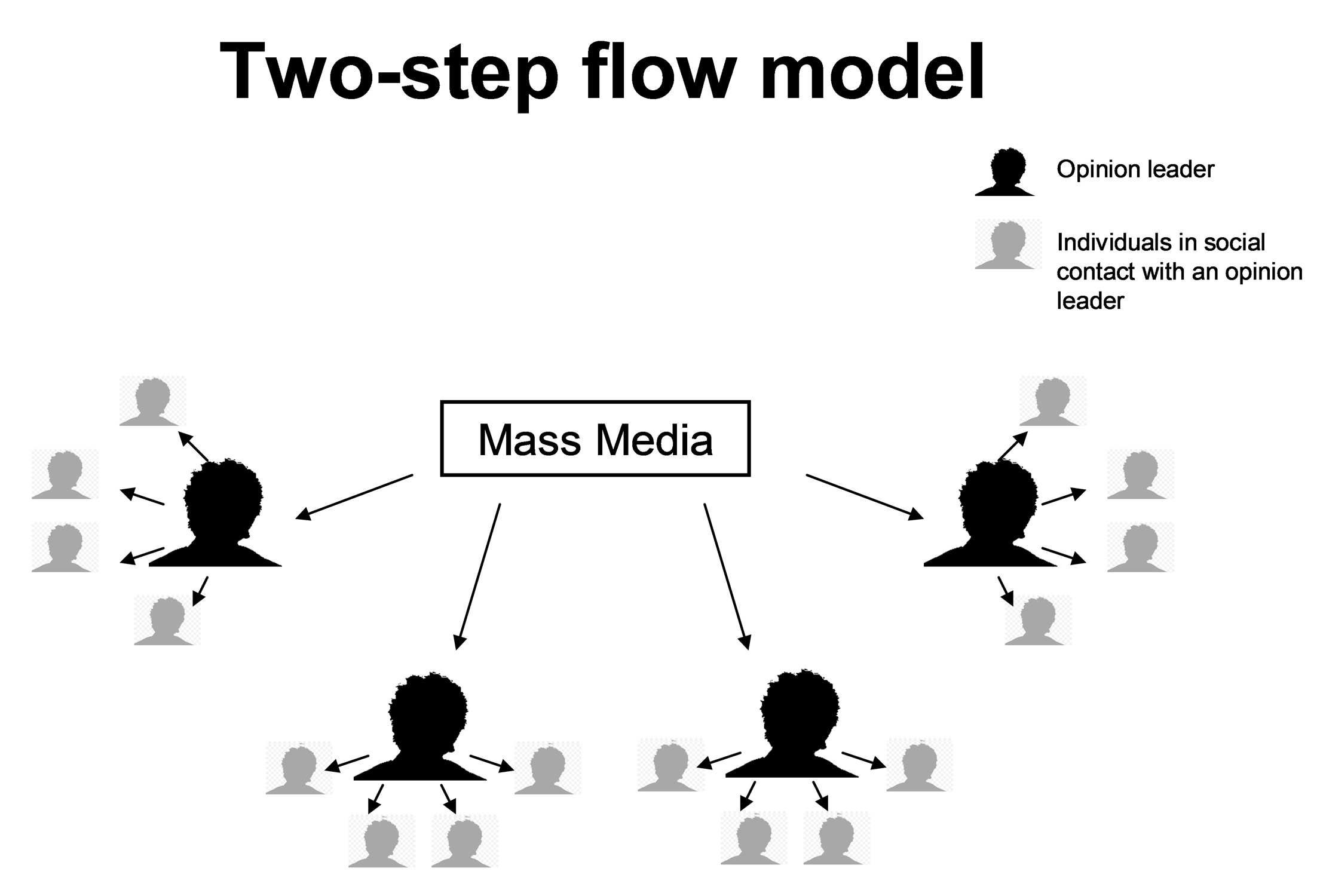
his theory asserts that information from the media moves in two distinct stages. First, individuals (opinion leaders) who pay close attention to the mass media and its messages receive the information. Opinion leaders pass on their own interpretations in addition to the actual media content. The term ‘personal influence’ was coined to refer to the process intervening between the media’s direct message and the audience’s ultimate reaction to that message. Opinion leaders are quite influential in getting people to change their attitudes and behaviors and are quite similar to those they influence. The two-step flow theory has improved our understanding of how the mass media influence decision making. The theory refined the ability to predict the influence of media messages on audience behavior, and it helped explain why certain media campaigns may have failed to alter audience attitudes an behavior. The two-step flow theory gave way to the multi-step flow theory of mass communication or diffusion of innovation theory.

The uses and Gratifications theory:
Initially, researchers approached the subject from the angle of how the media is able to manipulate audiences, injecting messages into their minds. This 'hypodermic' model, as it was later termed, became rejected after closer examination. The 'Uses and Gratifications' model represented a change in thinking, as researchers began to describe the effects of the media from the point of view of audiences. The model looks at the motives of the people who use the media, asking why we watch the television programmes that we do, why we bother to read newspapers, why we find ourselves so compelled to keep up to date with our favourite soap. The underlying idea behind the model is that people are motivated by a desire to fulfil, or gratify certain needs. So rather that asking how the media uses us, the model asks how we use the media.

Reception Theory:
A branch of modern literary studies concerned with the ways in which literary works are received by readers. The term has sometimes been used to refer to reader‐response criticism in general, but it is associated more particularly with the ‘reception‐aesthetics’ (German, Rezeptionsästhetik) outlined in 1970 by the German literary historian Hans Robert Jauss. Drawing on philosophical hermeneutics, Jauss argued that literary works are received against an existing horizon of expectations consisting of readers' current knowledge and presuppositions about literature, and that the meanings of works change as such horizons shift. Unlike most varieties of reader‐response theory, then, reception theory is interested more in historical changes affecting the reading public than in the solitary reader.




No comments:
Post a Comment